Lawn dethatching
Serving Oshawa and Durham Region
- Season
- Late April to May, or early fall
- Frequency
- When thatch tops 1 cm
- Typical visit
- 1 to 2 hours
The short answer
Thatch is the layer of dead stems and roots between the grass blades and the soil. Past about 1 cm it sheds water, starves the roots and shelters snow mould and insects. We power rake it out, ideally from late April to May once the lawn greens up, or in early fall.
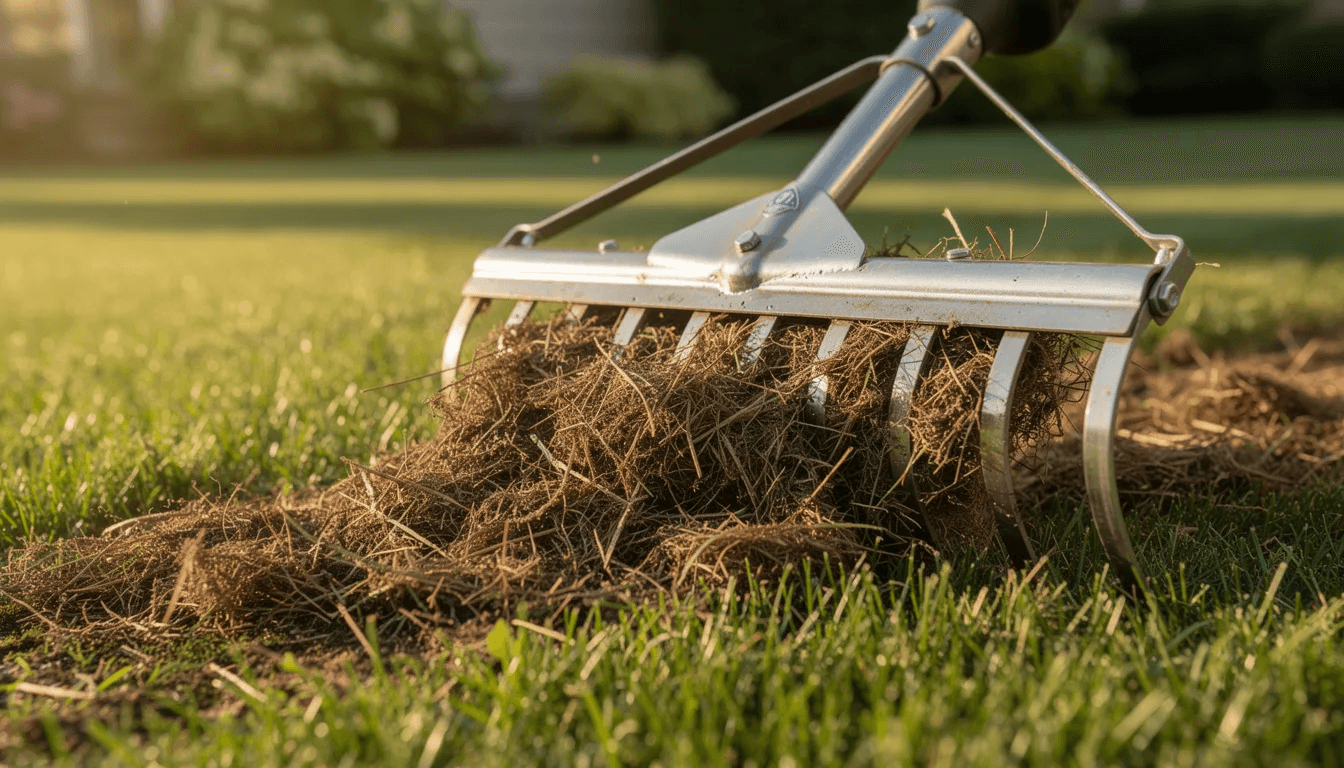
Thatch is not grass clippings. It is a dense layer of dead stems, crowns and roots that builds up between the green blades and the soil, and a bit of it, under 1 cm, is healthy padding. Past that, it behaves like a thatched roof: water beads and runs off, fertilizer never reaches the soil, and the layer itself becomes winter shelter for snow mould spores and insects like chinch bugs. Dethatching strips that layer out mechanically.
How we dethatch in Oshawa
- We measure before we bring the machine. A small wedge cut from the lawn shows the thatch depth directly. Under 1 cm, dethatching does more harm than good and we will tell you to keep your money.
- We run the power rake over the full lawn. Its vertical tines slice into the thatch layer and lift the dead material up onto the surface without turning the lawn over.
- We rake up and bag what comes loose. The volume surprises people; a neglected lawn can give up dozens of bags. Everything goes out as yard waste.
- We set the lawn up to recover. The turf looks thin for a couple of weeks, so we advise on watering, and the freshly exposed soil makes an ideal seed bed if you add overseeding.
When to dethatch in Durham Region
The lawn needs to be growing strongly enough to fill back in, which rules out most of the calendar. In Oshawa the best window is late April through May, once the lawn has fully greened up and had a cut or two, with early September as the backup. Midsummer heat and dormancy are the wrong time, and so is early spring on a lawn that is still pale; a dethatcher then rips out live grass along with the dead.
Signs thatch has crossed the line
The lawn feels spongy underfoot, like walking on carpet underlay. Water beads and runs off instead of soaking in. The grass browns quickly in summer heat because its roots sit in the thatch layer rather than the soil. And spring snow mould keeps returning to the same spots, because the fungus overwinters in the very layer causing the drainage problem. The wedge test settles it: cut a small plug and measure the brown layer between green growth and soil, or have us check it.
Dethatching, core aeration and overseeding fix different layers of the same problem, and tired lawns often want two of the three in the same season. If the buildup shows up during a spring cleanup, we can usually add the machine work the same week. Request a free quote and we will start with the wedge test.
What's included
- Wedge test to measure thatch depth
- Power raking of the full lawn
- Loosened thatch raked up and bagged
- Watering and recovery advice
- Optional overseeding onto the exposed soil
Dethatching, answered
Do mulched clippings cause thatch?
No. Clippings are mostly water and break down within days. Thatch comes from tougher material, stems, crowns and roots, and builds fastest on lawns that are overwatered, overfertilized or sitting on compacted soil where decomposition is slow.
How often should a lawn be dethatched?
Only when the layer tops about 1 cm, which for many lawns is never. Kentucky bluegrass builds thatch faster than ryegrass or fescue, so bluegrass-heavy lawns may need it every few years.
What is the difference between dethatching and aeration?
Dethatching removes the dead layer sitting on top of the soil; aeration opens up the soil itself. On Oshawa's clay, a lawn with thick thatch is often compacted too, and the two treatments pair well in the same season.
How rough will the lawn look afterwards?
Rough for two to three weeks. The power rake thins the lawn on purpose, so expect visible soil and raked-out debris. With water, and ideally overseeding, it comes back thicker than before.