When to aerate your lawn in Ontario
Also called best time to aerate lawn Ontario, lawn aeration timing
By Oshawa Lawn Care · Updated
- You need
- An aerator, A hose or sprinkler, Grass seed
- Effort
- Moderate
- Time
- About 1 h 30 min
The short answer
Aerate cool-season lawns in southern Ontario between mid-August and mid-September, when the grass is growing hard enough to fill the holes; April is the backup window. Lawns on clay or with heavy foot traffic need it every year, sometimes twice.
For Oshawa and the rest of southern Ontario, aerate between mid-August and mid-September. That is when Kentucky bluegrass, perennial ryegrass and fescue are growing hard again after the summer heat, so the holes you punch close over quickly and the seed you drop in them has six to eight weeks to establish before the ground freezes. April is the backup if you missed the fall, with a couple of conditions covered below. The rest of our lawn care guides assume the same calendar, because timing is most of what separates a lawn that responds from one that just looks chewed up for a month.
What you need
- A core aerator (rented for a half day, or a professional aeration visit)
- A hose or sprinkler to water the lawn a day or two ahead
- Grass seed if you are overseeding, which you should be
- Marking flags or spray paint for sprinkler heads, shallow cables and dog-fence wire
Why late summer beats every other date
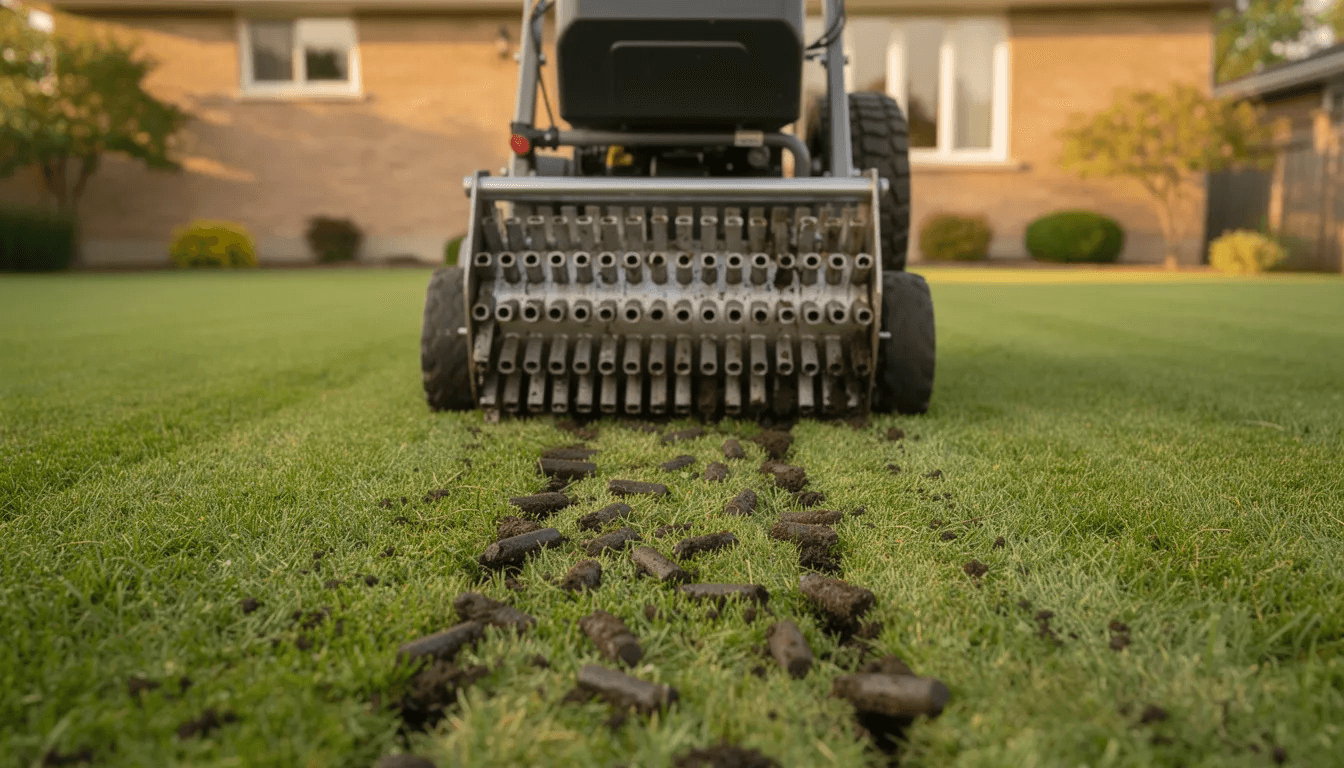
Core aeration pulls thousands of finger-sized plugs out of the lawn. On the heavy clay under most of Durham Region, that is the only thing that actually opens the soil: spike aerators and the shoes with nails on them push clay tighter, they do not loosen it. The plugs leave channels 5 to 8 cm deep that let rain soak in instead of running off, let air reach the roots, and let fall fertilizer get where it is going.
The reason the date matters is recovery. The grass has to grow into the holes, and cool-season grasses do their strongest root growth when soil is still warm but nights have cooled, which in Oshawa means the last two weeks of August through the middle of September. Weed pressure is dropping at the same time, so the open soil fills with grass rather than crabgrass. Fall rain usually arrives to do the watering. Everything lines up.
A warm fall stretches the window to early October. Past that, the soil is cooling, recovery slows, and seed will not have time to establish, so the job waits for spring.
Spring aeration: when it makes sense and when it backfires
April to mid-May works if the lawn was too wet or you ran out of fall. Wait until the ground has drained enough that the aerator pulls clean plugs instead of smearing mud, which on clay is usually two to three weeks after the last snow is gone.
Two cautions. First, spring aeration opens soil exactly when crabgrass and other annual weeds germinate, so the holes can fill with weeds before grass roots claim them. Second, if you use corn gluten meal as a pre-emergent, which is the usual choice under Ontario’s cosmetic pesticide rules, aerating after you apply it breaks the barrier. Aerate and seed first, then apply, or skip the pre-emergent that year. Spring also puts new seedlings straight into July heat, which is why we treat it as a repair window, not the main event.
How often a Durham lawn needs it
- Clay soil, kids, dogs, or a path worn across the yard: every year, and twice a year (spring and late summer) for the first year or two of bringing a compacted lawn back.
- Lighter soil and little traffic: once a year, or every second year if the lawn drains well and stays thick.
- Brand new sod or seed: not until it has been through a full growing season.
The screwdriver test settles most arguments: if a screwdriver will not slide into the lawn with hand pressure the day after a rain, the soil is compacted enough to aerate. Water pooling or running off, thinning grass along the fence line, and a thatch layer thicker than about 1 cm are the other signs.
How to core aerate, step by step
- Water the lawn 24 to 48 hours ahead. About 2.5 cm, so the tines pull full plugs; dry clay just bounces the machine.
- Mow a notch shorter than usual and flag every hazard. Sprinkler heads, shallow irrigation lines, dog-fence wire and cable drops sit within the 8 cm the tines reach.
- Run the aerator in two directions. One pass lengthwise, one across, with extra passes on the worn path to the shed or the strip by the driveway.
- Leave the plugs where they fall. They crumble in two to three weeks and carry soil life back to the surface. Raking them off throws away the benefit.
- Overseed within 48 hours. Seed that falls into the holes gets soil contact and shelter, which is the whole point of pairing the two jobs.
- Fertilize and water. A fall fertilizer the same week reaches the roots through the open channels; then keep the top centimetre damp for two weeks if you seeded, or water deeply once a week if you did not.
Skip the mower for about a week so the seedlings and the recovering turf are not sheared off, then mow as normal at the usual height.
What the lawn looks like afterwards
Rough, for about ten days. The plugs lie on the surface and the holes stay visible until the grass grows over them. Then the lawn turns a shade greener, feels springier underfoot, and drinks up the next rain instead of shedding it. If it does not, the compaction is deeper than one pass reaches, and the answer is a second aeration next season rather than more fertilizer now.
Aeration on its own fixes the soil. Aeration plus overseeding plus fall feeding fixes the lawn, and the reason we push customers toward the mid-August to mid-September window is that it is the only time of year all three work together. Our guide to preparing your lawn for fall walks through the rest of that sequence.
Tips
- Rent the heaviest walk-behind core aerator the shop has. The light ones skip across dry clay and pull shallow plugs.
- If the forecast shows a dry week, check the rain gauge on our homepage before you water in the new seed; a good soaking rain counts toward the total.
- Mark the date you aerated on the calendar. The clearest sign the lawn needed it is how much better the same week looks a year later.
Our core aeration visits run mid-August to mid-September, with overseeding as an option while the holes are open. Request a free quote
When to aerate your lawn in Ontario, answered
Is October too late to aerate a lawn in Ontario?
Early October is usually fine in a mild fall, but recovery slows as the soil cools and any seed you drop in the holes may not establish before winter. After mid-October, wait for spring.
Should I aerate before or after fertilizing?
Aerate first. Fertilizer applied the same day or within a week reaches the root zone through the open holes instead of sitting on the surface.
Can I aerate when the lawn is wet?
Moist is ideal, soggy is not. On clay, a waterlogged lawn smears instead of coring and the machine leaves ruts. Water a day or two before, then let the surface drain.
Does a new lawn need aeration?
Not in its first year. Sod needs a full season to root and new seed needs at least one, so the earliest sensible aeration is the following late summer.
How long until the lawn looks normal again?
The plugs crumble away within two to three weeks and the holes close as the grass grows. By about a month later the lawn is greener and springier than before.